
If you are planning to demolish a house, garage or commercial building in Kamloops, a hazardous materials survey comes first. British Columbia’s workplace safety regulation requires one before demolition or renovation work begins, and the City of Kamloops asks for a Hazardous Materials Report with any homeowner demolition permit for a building built before 1990. This guide explains what is required, what the survey covers, and what happens to the materials it finds.
Is a hazmat survey required before demolition in Kamloops?
Yes. Under section 20.112 of WorkSafeBC’s Occupational Health and Safety Regulation, before work begins on the demolition or salvage of a building or structure, or the renovation of one, the employers responsible for the work and the owner must ensure that a qualified person inspects the building and the worksite to identify any hazardous materials. The regulation does not set a construction-year cutoff: the inspection applies to any building being demolished or renovated.
The City of Kamloops adds its own requirement. Its homeowner demolition permit checklist asks for a Hazardous Materials Report if the building was built before 1990, and a Clearance Letter from an abatement company confirming that all hazardous materials have been properly removed from the structure.
What counts as a hazardous material?
The regulation defines hazardous materials as hazardous substances, or materials containing them, that may be handled, disturbed or removed during the work, including:
- asbestos-containing material
- lead or any other heavy metal
- toxic, flammable or explosive material
In older Kamloops buildings, asbestos is the one most often found. The City lists drywall and joint compound, plaster, vinyl flooring and levelling compound, ceiling tiles, cement pipe, stucco and cement siding, and spray-applied and attic insulation as potential asbestos-containing materials.
What a hazardous materials survey includes
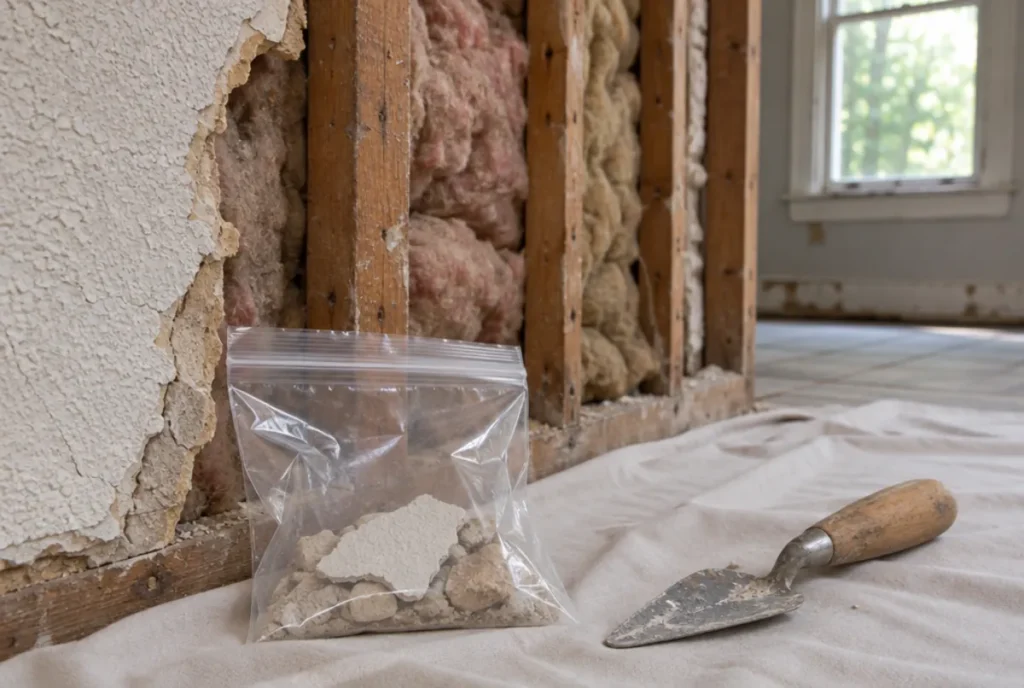
The regulation sets out what the qualified person must do. In practice, a survey before demolition looks like this:
- Inspection of the whole building and site, including materials hidden in walls, ceilings, floors and mechanical systems that demolition will disturb.
- Representative sampling of any material that may be hazardous, with each sample identified and its location recorded.
- Laboratory analysis to confirm whether each sample is a hazardous material.
- A written report that gives the location of each sample and each hazardous material found, using drawings or plans where needed, the methods used, and the approximate quantity of each material.
That written report must be available at the worksite while the work goes on, and it is the document the City of Kamloops asks for with a pre-1990 demolition permit. If the job needs a notice of project for asbestos or lead work, a copy of the report goes to WorkSafeBC with that notice.
What happens after the survey
If the survey finds hazardous materials, demolition cannot go ahead until they are dealt with. The regulation states that no demolition, salvage or renovation work that may disturb the hazardous materials can be carried out, apart from work to safely contain or remove them, until they are safely contained or removed. A qualified person must then confirm in writing that this has been done.
The same rules cover material found later. If something that may be hazardous turns up after that written confirmation, a qualified person must sample it, determine whether it is hazardous and write a new report, and work that could disturb it waits until it is safely contained or removed.
Since January 1, 2024, asbestos abatement employers in BC must hold a licence from WorkSafeBC, and the workers doing the removal must be trained and certified. You can check a contractor on WorkSafeBC’s registry of licensed asbestos abatement contractors before you hire. Where the work involves moderate- or high-risk work with asbestos-containing material, or significantly disturbs lead-containing material, WorkSafeBC must also receive a notice of project at least 48 hours before that work begins.
For the City’s permit, the abatement company’s Clearance Letter confirms that removal is complete.
From survey to demolition permit, step by step
For a pre-1990 building, the steps run in this order:
- Book the survey and review the written report of what was found, where it is and roughly how much there is.
- If hazardous materials were found, hire a licensed abatement contractor, with any required notice of project sent to WorkSafeBC at least 48 hours before that work starts.
- After removal, collect the written confirmation and the abatement company’s Clearance Letter.
- Gather the City’s documents: a title search dated within the last three months (through LTSA.ca), an agency agreement if you are applying for the owner, the Hazardous Materials Report, the Owner’s Acknowledgement, a site plan showing the square footage of the building to be demolished, and the Clearance Letter.
- Apply online through a MyCity profile. Once you start the application, you have 30 days to submit it.
- Disconnect the utilities. Demolition must not proceed until every utility service that may endanger a worker is disconnected the way the utility owner requires.
Disposing of demolition waste in Kamloops
The City of Kamloops treats potential asbestos-containing materials from a building constructed before 1990 as asbestos-containing, unless a hazard assessment with lab results is provided in advance. That is one of the most practical reasons to test before demolition: tested, asbestos-free material can be disposed of normally once the landfill has pre-approved the hazard assessment and lab results, while untested material from an older building has to be handled as if it contains asbestos.
According to the City:
- Potential asbestos-containing loads are accepted only at the Mission Flats Landfill, not at the Kamloops Resource Recovery Centre or the Barnhartvale Landfill.
- Every load that includes these materials needs a signed Asbestos Declaration and Acknowledgement Form, regardless of age or test results.
- Asbestos-containing material must be double-bagged in bags at least 6 mil thick and sealed with tape. A standard contractor bag is only 2 to 3 mil and is not acceptable.
- Larger asbestos-containing loads need landfill pre-approval and 48 hours’ notice, with the hazard assessment and lab results attached where applicable.
- Untested material from a pre-1990 building is limited to small residential quantities, up to 15 bags per customer per week.
Check the City’s Asbestos Abatement and Safe Disposal page for current fees and forms before you book a load.
Should you test if your building was built after 1990?
Asbestos was phased out of building products in Canada around 1990, so newer buildings are much less likely to contain it. The provincial inspection requirement still applies to demolition and renovation regardless of age, though, and other hazardous materials, such as lead paint or stored chemicals, are not tied to that date. A survey is the only way to confirm what is in a building.
Hazmat surveys in Kamloops and the Thompson-Nicola
Epoch Environmental Consulting carries out asbestos inspections, asbestos testing, hazardous materials inspections, mould testing and environmental testing from our office at 348 Tranquille Road in North Kamloops. Our written reports identify each hazardous material, where it is and the next steps, so you can hand them straight to your contractor, your abatement company or the City for permitting. Call (250) 980-6925 to book a survey before your demolition.
Frequently asked questions
Do I need an asbestos test before demolishing a house in Kamloops?
Yes. WorkSafeBC requires a qualified person to inspect a building for hazardous materials, including asbestos, before demolition begins. The City of Kamloops also asks for a Hazardous Materials Report with a homeowner demolition permit if the building was built before 1990, plus a Clearance Letter from an abatement company once materials are removed.
What is in a hazardous materials report?
Under WorkSafeBC’s regulation, the written report lists the location and identity of each sample, whether it is a hazardous material, the methods used, the location of each hazardous material found (using drawings or plans where needed), and the approximate quantity of each.
Where can I dispose of asbestos waste in Kamloops?
Potential asbestos-containing loads are accepted only at the Mission Flats Landfill. They must be double-bagged in sealed 6-mil bags and come with a signed Asbestos Declaration and Acknowledgement Form. Larger loads need pre-approval and 48 hours’ notice.
Can demolition start while asbestos is still in the building?
No. Work that may disturb identified hazardous materials cannot proceed, other than to contain or remove them, until a qualified person confirms in writing that they have been safely contained or removed.
Does the City treat untested drywall from an older house as asbestos?
Yes. Unless a hazard assessment with lab results is provided in advance, potential asbestos-containing materials from a building built before 1990 are treated as asbestos-containing for disposal.